If you score a long translation with one metric alone, you will miss errors. That is the bottom line.
I’d sum it up like this: sentence scores are not enough for long documents, and each metric checks a different type of problem. BLEU, chrF, and TER mostly look at wording or edit distance. COMET, BLEURT, and BERTScore look more at meaning. COMET-QE works without a reference. BLONDE and Cont-COMET look more at cross-sentence links like pronouns, term drift, and section-to-section consistency.
If you need a simple rule, here it is:
- Use overlap metrics for a basic baseline
- Use learned metrics for meaning-level review
- Use QE metrics when no reference exists
- Use discourse-aware metrics when context across sentences matters
- Never rely on one score alone for long technical content
This matters more in fields like AEC, manufacturing, and aerospace, where a small wording shift can change instructions, specs, or approvals. In many pipelines, a single document may contain dozens or hundreds of segments, so chunking alone can hide cross-sentence mistakes.
AI-Powered Translation Scoring: Scaling Quality with MQM Framework
Quick Comparison
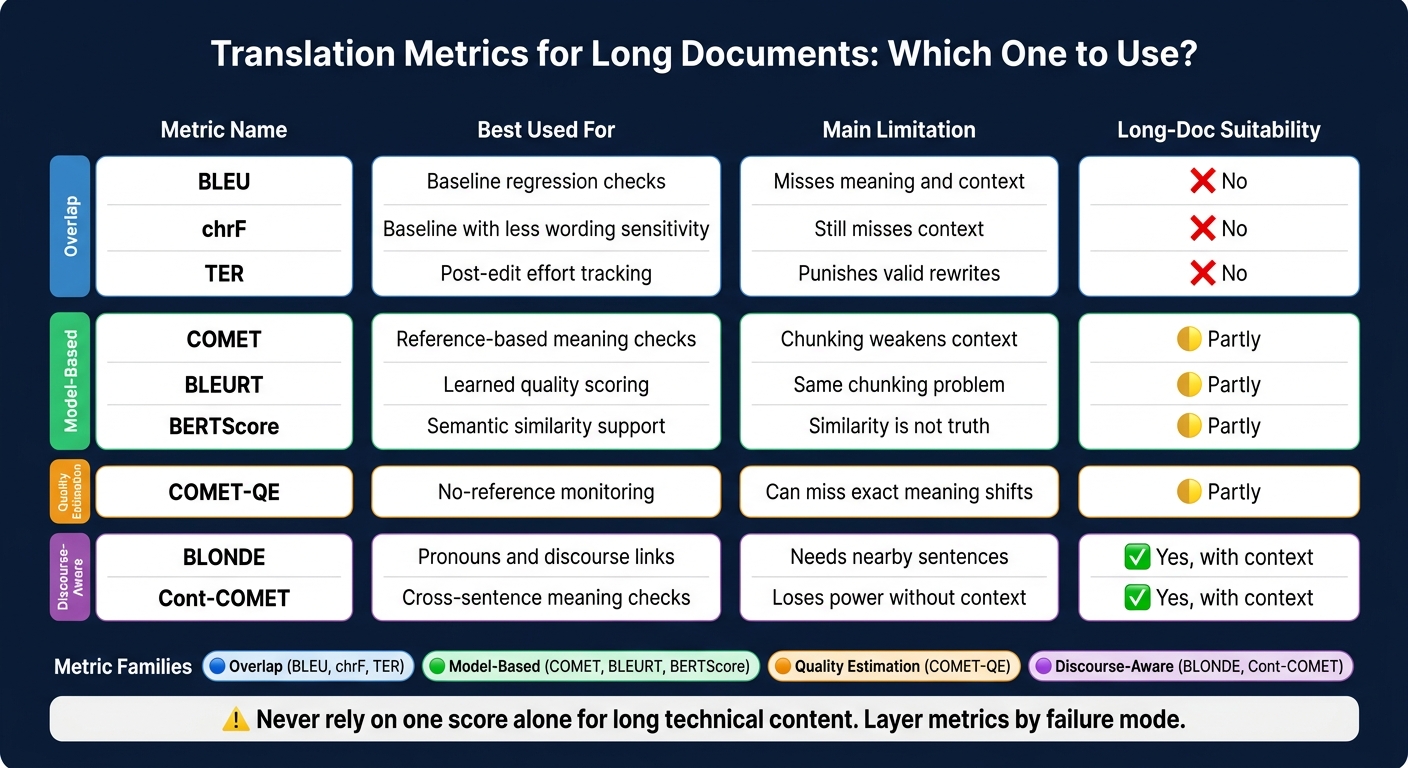
Translation Metrics Compared: Which One to Use for Long Documents
| Metric | What I’d use it for | Main limit | Best fit for long documents? |
|---|---|---|---|
| BLEU | Baseline regression checks | Misses meaning and context | No |
| chrF | Baseline with less wording sensitivity | Still misses context | No |
| TER | Post-edit effort tracking | Punishes valid rewrites | No |
| COMET | Reference-based meaning checks | Chunking weakens context | Partly |
| BLEURT | Learned quality scoring | Same chunking problem | Partly |
| BERTScore | Semantic similarity support | Similarity is not truth | Partly |
| COMET-QE | No-reference monitoring | Can miss exact meaning shifts | Partly |
| BLONDE | Pronouns and discourse links | Needs nearby sentences | Yes, with context |
| Cont-COMET | Cross-sentence meaning checks | Loses power without context | Yes, with context |
My short take: for production use, I’d layer metrics instead of chasing one “best” score. Start with a low-cost baseline, add a meaning-focused metric, then add discourse or terminology checks if the document has heavy cross-references.
That gives you a much better shot at finding the errors that sentence-level scoring leaves behind.
1. BLEU
Signal captured
BLEU measures n-gram overlap between a machine translation and a human reference translation, and it includes a brevity penalty. In plain English, it checks how much the system output matches the reference at the word and phrase level.
That means BLEU rewards wording overlap, not meaning. A translation can keep the intended meaning and still get a lower score if it uses different phrasing than the reference.
Failure modes
BLEU often drops on technical documents when terminology, word order, discourse, or paraphrasing differs from the reference. That happens a lot in technical writing, so BLEU scores can drift away from human review even when the translation is perfectly reasonable.
This is the core problem: BLEU is good at spotting surface matches, but it’s not very good at asking, “Did this say the same thing?”
Long-document handling
BLEU does not track document context. So it misses errors that depend on earlier or later sections.
If a term changes halfway through a document, or if one section contradicts another, BLEU won’t reliably catch it.
Production fit
For document-level translation, BLEU is a coarse baseline, not a stand-in for coherence, context carryover, or terminology consistency. It can miss confident errors and cannot detect contradictions or missing context across sections.
Do not use BLEU alone for document-level quality gates.
As an overlap baseline, BLEU is useful only as a starting point. The next metric reduces some of BLEU’s wording sensitivity.
2. chrF
BLEU leans on exact word overlap. chrF is less brittle when the wording shifts.
chrF is a stronger overlap baseline than BLEU in cases like this because it scores similarity at the character level, not just through exact word matches. That gives it more room to handle morphological changes, alternate phrasing, and term variation that BLEU may punish even when the meaning is still close.
That said, chrF has the same big limit as BLEU: it does not model document context. So it can’t judge coherence, coreference, or consistency across sentences.
Even so, chrF is still an overlap metric, not a context-aware one.
3. TER
Unlike BLEU and chrF, TER looks at correction effort instead of n-gram overlap.
Signal captured
TER, or Translation Edit Rate, estimates post-editing effort by counting how many edits it takes to change machine-translated output into the reference. Lower TER usually means better quality.
That edit-based view fits post-editing work quite well. If a translator has to make fewer fixes, the output is usually in better shape.
Failure modes
TER can punish valid paraphrases and changes in word order. In technical content, terminology variation and valid rewording may look like errors to TER even when the translation is accurate and smooth.
That can skew scores in technical documents, where different phrasing can still keep the same meaning.
Long-document handling
TER scores each segment on its own, so it can’t follow terminology consistency, coreference, or coherence across a full document. As a result, TER does a poor job of spotting terminology drift from one section to another in long technical documents.
Production fit
TER works best as a proxy for post-editing effort in human-in-the-loop workflows.
It’s weak as a standalone document-level signal because it measures edits, not meaning or consistency. The next metric shifts from edit distance to learned semantic similarity.
4. COMET
COMET changes the comparison from edit distance to learned semantic scoring.
It’s a learned metric that scores translation quality against a reference by looking at meaning, not just exact word overlap.
Failure modes
In long documents, chunking creates a chunk-size tradeoff. Small chunks miss cross-sentence context. Large chunks can blur local meaning.
That’s where things start to slip. You can get terminology drift, weaker coherence, and details that aren’t well supported because the model only sees a limited slice of the document at a time.
Long-document handling
COMET is useful when terminology needs to stay steady across sections and references, such as in AEC, manufacturing, and aerospace documents, because it aims at cross-sentence meaning drift.
But there’s a catch: if you score documents in isolated chunks, that signal starts to fall apart.
Production fit
In production, pair COMET with terminology and coherence checks. Don’t score long documents from isolated chunks alone.
BLEURT follows a similar learned-metric path, but with a different error profile.
5. BLEURT
BLEURT sits in the same learned-metric group as COMET, but it gets to its score in a different way.
COMET is trained on human quality judgments. BLEURT, by contrast, fine-tunes a pretrained language model on synthetic rating data. In plain English, that helps BLEURT pick up meaning changes that overlap metrics like BLEU and chrF can miss.
There’s a catch on long technical documents. BLEURT runs into the same chunking issue as COMET: when you score isolated segments, the model loses the cross-sentence context it needs to judge coherence and terminology consistency with confidence.
So BLEURT works well as a learned baseline, but it’s not a complete answer for document-level coherence.
6. BERTScore
Signal Captured
Compared with COMET and BLEURT, BERTScore is a lighter semantic similarity check, not a learned quality model. It compares contextual embeddings at the token level between the candidate translation and the reference.
Put simply, BERTScore looks past plain word overlap. It asks whether the candidate and reference mean roughly the same thing, even when they use different wording. That gives it a semantic similarity signal that basic matching methods tend to miss.
Failure Modes
Here’s the catch: similarity is not correctness. BERTScore has no mechanism for logical or factual verification, so it cannot detect contradictions, temporal drift, or factual errors.
That means a translation can sound close to the reference and still be wrong. If a sentence flips the meaning, changes a date, or slips in a false claim, BERTScore may still give it a decent score because the wording lives in a similar semantic neighborhood.
Long-Document Handling
Long documents are where things get messy. Small segments lose cross-sentence context, while larger spans can wash out local mistakes.
In long technical specs, this tradeoff shows up fast. A document can still score well overall even when terminology drifts or cross-references break in one section. So the top-line score may look fine, while a bad section hides in plain sight.
Production Fit
Use BERTScore as a supporting signal for multi-section reasoning, not as a standalone gate. It works best as one input among several, especially when you need to judge long or detail-heavy content.
That limitation is why document-level evaluation usually pairs BERTScore with stronger coherence checks or reference-free checks.
7. COMET-QE
COMET-QE shifts the focus away from reference-based similarity and toward quality estimation without a reference.
Signal Captured
COMET-QE is a reference-free metric. It scores translation quality using only the source text and the machine translation output, with no human reference required.
That makes it a good fit for production setups where reference translations don’t exist or cost too much in time and money.
Failure Modes
There’s a clear tradeoff here. Without a reference, COMET-QE can’t check whether the translation preserves the exact meaning of the source.
As a result, it can miss subtle errors that a reference-based metric would catch. This shows up more often in technical content, where precise wording matters and small shifts in meaning can cause trouble.
Long-Document Handling
Like other COMET-family metrics, COMET-QE is sensitive to chunking. If you score isolated segments, you lose the cross-sentence context the model needs to judge coherence and terminology consistency across a full document.
That can be a problem for long files. A sentence may look fine on its own but feel off once you read it in the flow of the full text.
Production Fit
COMET-QE is most useful when reference translations aren’t available, such as in high-volume or continuous delivery pipelines.
If document-level consistency is a hard requirement, pair it with reference-based metrics and terminology checks. The next metric, BLONDE, takes a different approach by targeting discourse structure directly.
8. BLONDE
BLONDE covers a more specific slice than semantic similarity metrics. It focuses on discourse links across sentences.
Signal Captured
BLONDE looks at cross-sentence discourse relations, with a strong focus on pronoun resolution and orphaned references [1].
Failure Modes
If you score text in isolation, those links get weaker. Very small chunks can break discourse connections at sentence boundaries, which lowers the discourse signal [1].
Long-Document Handling
BLONDE works best when neighboring sentences stay inside the same scoring window. If the chunks are too small, its ability to detect discourse relations drops [1].
Production Fit
BLONDE is a good fit when scoring windows keep sentence-to-sentence discourse intact. Without neighboring sentences, it loses most of what makes it useful.
So in practice, BLONDE works well for discourse-sensitive checks, but it is not the right tool for broader coherence modeling across full documents.
9. Cont-COMET
Signal Captured
BLONDE pays close attention to discourse links. Cont-COMET goes a step further by adding context. It looks at the sentences around a segment to score meaning across sentence boundaries.
That matters because some mistakes don’t show up in a single sentence. They only appear when you read two or three sentences together. Cont-COMET can catch issues like terminology drift and pronoun resolution errors [1].
Failure Modes
Its main weak spot is simple: it needs context to work well.
If the surrounding sentences aren’t there, the metric loses the cross-sentence signal it depends on. At that point, part of what makes Cont-COMET useful is gone.
Long-Document Handling
For long technical documents, Cont-COMET needs neighboring sentences to spot consistency and referential signals across segments [1]. In plain English, if related sentences get split apart during scoring, the metric has less to work with.
Its value depends on keeping nearby sentences together.
Production Fit
Cont-COMET is a good fit for technical manuals where consistent terminology and clean pronoun reference matter. That’s the kind of writing where one small shift in wording can snowball into confusion.
Without adjacent context, though, it behaves much more like sentence-level COMET.
Tradeoffs and Metric Selection for Production
No single metric does it all. Each metric family has a specific role, and teams get better results from automated translation evaluation when they match the metric to the kind of mistake they want to catch.
Use the matrix below to connect each metric family to the error class it handles best.
| Metric Family | Pros | Cons | Reference Required | Technical-Doc Suitability | Automation Reliability |
|---|---|---|---|---|---|
| Overlap (BLEU, chrF) | Fast, low cost, good for regression tracking | Misses semantic meaning and causal chains | Yes | Low | High (for syntax only) |
| Model-Based (COMET, BLEURT) | High semantic fidelity; correlates well with human judgment | Compute-intensive; less interpretable | Yes | High | High |
| Quality Estimation (COMET-QE) | Enables live monitoring; no reference needed | Can be overconfident on wrong outputs | No | Medium | Moderate |
| Discourse-aware (BLONDE, Cont-COMET) | Catches consistency issues across sections; handles multi-hop reasoning | Requires context windows and discourse modeling | Yes | Very High | High when paired with consistency checks |
What matters in production is simple: keep nearby context intact and pick the metric based on the failure mode. A syntax-focused regression check needs a different tool than a semantic review. And if you’re watching output live, you’ll want something different again. In practice, teams usually layer metrics by job: regression first, semantics next, live monitoring after that, and then discourse checks.
Metric choice also won’t rescue bad segmentation. If related sentences get split apart, discourse metrics lose part of the story. That’s why nearby context should stay preserved for discourse checks, and centralized terminology dictionaries should be used to keep terms consistent across documents.
Conclusion
No single metric catches every document-level error.
That’s the main point here: use layered evaluation. Start with fast baselines, add reference-free monitoring, and include discourse-aware checks for consistency.
Why does that matter? Because a metric can miss its own weak spots and still let bad output slip through without any warning. When you layer metrics, you cover more failure modes and cut down those silent misses.
FAQs
Which metric should I start with?
Start by defining what success looks like before you choose a formula. That sounds simple, but it changes the whole project. Instead of starting with a framework and hoping it fits, begin with one high-value knowledge domain where the pain is obvious and the ROI can be measured.
Then tie your metrics to business goals. For example, you might look at answer correctness against domain-expert ground truth or faithfulness to source documents. Those numbers matter more when you compare them to the manual process people use today and track outcomes that show clear business value.
How big should scoring chunks be?
Chunk size needs to strike a balance between context and precision.
If a chunk is too small, it can lose details that matter. That might mean missing a pronoun reference, dropping a step in a method, or stripping away the bit of context that makes the passage make sense.
Go too far in the other direction, and you run into a different problem. Large chunks - especially those over 2,000 tokens - can get too broad for accurate retrieval. Instead of pulling back the exact passage you need, the system may surface something more generic.
A common middle ground is 512 to 1,024 tokens with overlapping windows. That setup often works well because it gives each chunk enough context without making it too broad.
That said, rigid token counts aren’t always the best fit. In many cases, natural content boundaries - like paragraph breaks, section shifts, or complete thoughts - do a better job than slicing text at fixed intervals.
When do I need discourse-aware metrics?
You need discourse-aware metrics when standard translation evaluation - often built on artificial chunking - misses the meaning of the document as a whole.
They matter most for long, technical documents, where one sentence often leans on an earlier method, term, or pronoun reference. In that kind of writing, sentence-by-sentence scoring can miss what’s actually going on. Discourse-aware metrics help keep the full thread intact across segments, so the translation stays coherent and references remain accurate. That’s a big deal for trust in complex, document-heavy workflows.