Most operator copilots don’t fail on answers. They fail on escalation. When a case needs a supervisor, engineer, or ticket queue, value is lost if the handoff drops plant state, sends the issue to the wrong owner, or leaves the operator with no clear next step.
Here’s the short version:
- Problem: the next person gets a chat transcript, not a case they can act on
- Main gaps: missing context, weak routing, and hard-to-find escalation actions
- What must pass through: asset data, machine state, alarms, batch or lot ID, safety and quality impact, actions already tried, severity, owner team, SLA, and timestamps
- What works: visible escalation buttons, role-based routes, fixed rules for risk and confidence, and audit records that don’t change
- What this affects: downtime, SLA misses, rerouting, and audit risk
A simple test I use is this: can the reviewer act at once, or do they have to rebuild the case from scratch? If they have to start over, the handoff failed.
In many AI-driven manufacturing operations, even a small delay can turn into lost hours, repeat triage, and extra cost. That’s why the handoff needs to move a structured packet, not just conversation history.
The core idea is simple: good handoffs carry plant context, proof, ownership, and rules. Everything else is secondary.
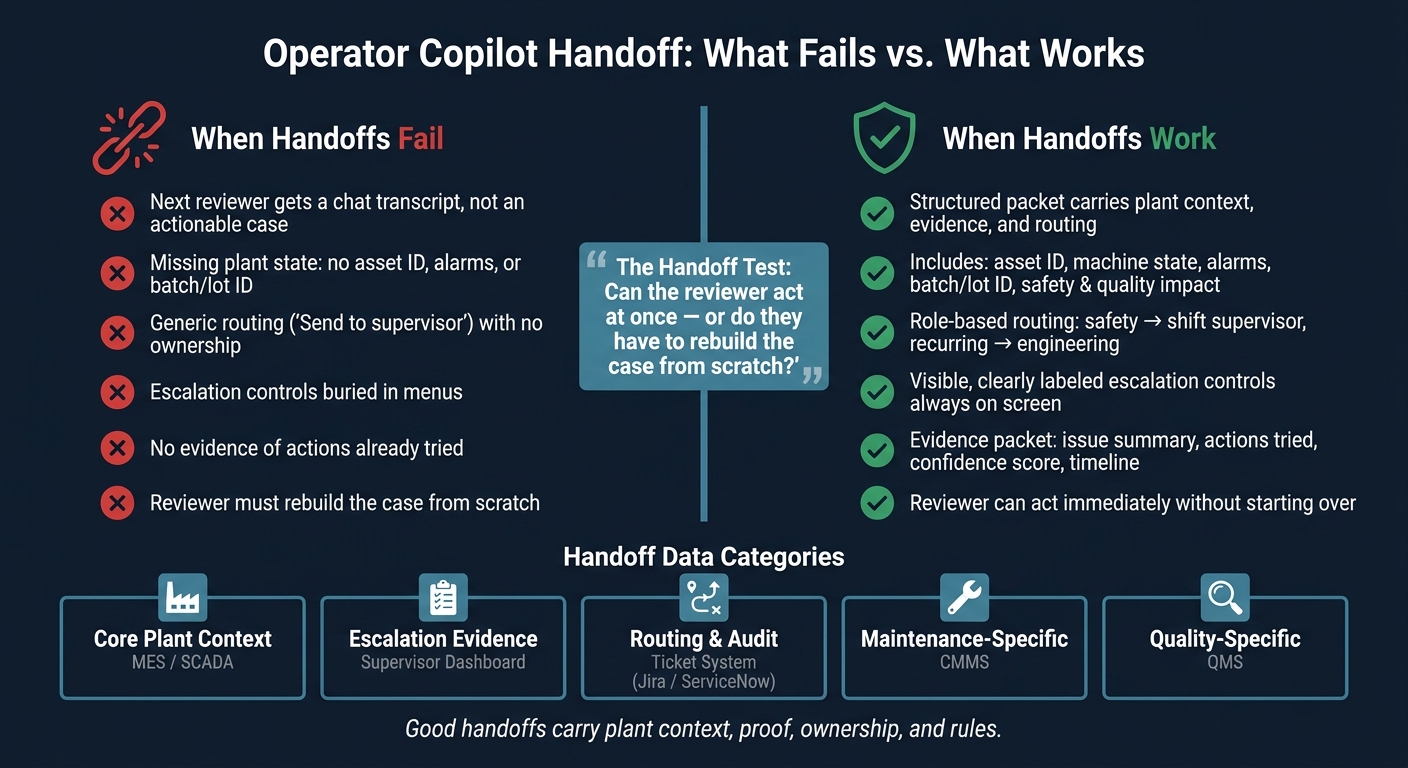
Operator Copilot Handoff: What Fails vs. What Works
Where operator copilot handoffs break down
Most handoff problems come from three places: missing context, unclear routing, and buried controls. The breakdown happens when the next reviewer gets a transcript instead of something they can act on right away.
Missing context and transcript-only handoffs
A transcript shows the conversation. It does not show the plant state.
That means the reviewer still has to piece the case back together before doing anything. They have to figure out what happened, what system is involved, what evidence matters, and what decision is waiting on them. So the transcript becomes a starting point, not a handoff record.
Even a solid summary won’t save the process if the case goes to the wrong place.
Ambiguous routing and unclear ownership
Generic labels like “Send to supervisor” fall apart fast when an issue could belong to more than one queue.
If routing doesn’t account for severity, issue type, or the system that owns the issue, the handoff either lands with the wrong team or just sits there with no owner. And if nobody is assigned to that escalation class, the copilot has nowhere steady to send it.
Buried escalation controls and no clear action
Under pressure, operators don’t go digging through menus for escalation controls. If the handoff action isn’t visible, clearly labeled, and connected to the task they’re doing right now, it gets missed.
And if the operator can’t tell what will happen after they escalate, the handoff slows down. People hesitate when the next step feels foggy.
The fix starts by defining what the handoff needs to carry and where it needs to go. This is a critical step when deploying AI agents in manufacturing.
That means a defined handoff packet: plant context, evidence, and routing fields.
What data must pass through a successful handoff
A successful handoff gives the next reviewer the facts they need in a structured format.
Core plant context: safety, asset, quality, and production state
The next reviewer needs the plant state, not a long transcript.
At a minimum, the handoff should include the asset or line, machine state, alarm history, work order or batch/lot ID, timestamp, safety risk, and any quality impact. If the escalation is tied to maintenance or quality, add the fields that fit that path. That can include LOTO status, parts required, technician availability, defect class, SPC signals, quality hold status, or inspection records.
If those details are missing, the reviewer has to dig them up by hand. That slows things down and increases the odds of someone working from stale data.
The escalation evidence packet for human review
Plant state alone isn’t enough. The handoff also needs a compact evidence packet for human review.
That packet should include a plain-language issue summary, the reason escalation was triggered, a short timeline, affected assets or lines, what the operator or AI has already tried, and the confidence score. Low-confidence or high-risk cases should go to human review, and the packet should spell out what has already been attempted. That way, the engineer doesn’t waste time repeating troubleshooting steps that already failed.
Routing and audit fields for ticket systems
Ticket systems also need clean, structured fields. Include severity, business impact, owner team, SLA priority, policy ID, work order or batch ID, and timestamps.
Write timestamps and IDs as fixed fields, not free text, so downstream systems can process them the same way every time. The audit trail should also show who initiated the handoff, when it happened, and which escalation policy was used.
| Handoff Data Category | Key Fields | Primary Downstream System |
|---|---|---|
| Core Plant Context | Asset ID, line, machine state, alarm history, batch/lot ID | MES / SCADA |
| Escalation Evidence | Issue summary, timeline, actions taken, confidence score, recommended next step | Supervisor dashboard |
| Routing & Audit | Severity, business impact, owner team, SLA priority, policy ID | Ticket system (Jira / ServiceNow) |
| Maintenance-Specific | LOTO status, parts required, technician availability, failure mode | CMMS |
| Quality-Specific | Defect class, SPC signals, quality hold status, inspection records | QMS |
With the payload defined, the next step is making escalation visible, structured, and role-based.
How to design escalation flows that work in production
Make escalation visible, structured, and role-based
Don’t bury escalation in a menu. Operators move fast on the plant floor. If the path to human review isn’t obvious, they’ll guess or skip it.
Escalation controls should stay visible at all times, with plain language that shows exactly when a handoff is required. That path should line up with the handoff packet defined above. The point is simple: when someone needs to step in, the next move should be obvious.
Routing by role matters just as much as visibility. A safety flag should go to the shift supervisor, not the maintenance queue. Recurring issues should go to engineering, not a shared inbox. Supervisor, engineer, maintenance, quality, and safety each need their own path and a clear owner. That way, the reviewer gets a decision package they can use right away, without the usual back-and-forth.
If operators are bypassing the flow, that’s a design problem, not a training problem.
Low adoption means the handoff flow is broken, not that operators need more training.
Route by risk, confidence, and system of record
Not every issue needs a supervisor. Routing logic should match actual plant risk.
Low-confidence AI outputs, safety-sensitive actions, and irreversible decisions need approval gates and human sign-off before anything moves ahead. Routine maintenance flags and minor issues can go straight into the CMMS or ticketing system through the standard workflow.
One routing rule should map to one escalation outcome.
| Trigger | Escalation Target | Action |
|---|---|---|
| Critical safety or quality defect | Shift supervisor | Immediate line hold; emergency page |
| Recurring pattern or root cause | Engineering | Correlation analysis; process adjustment |
| Low confidence or ambiguous data | Human reviewer | Manual review; data correction |
| Routine maintenance or minor issue | Ticket system / CMMS | Standard work order creation |
| Cost or production-impact threshold breach | Plant leadership | Approval gate for financial or strategic risk |
Use fixed rules for asset IDs, severity, and SLA priority. Don’t let the model infer them.
Those routes should then be monitored and adjusted based on what happens after the handoff. If a route keeps ending in rerouting, delay, or override, something is off.
Use governance and observability to improve handoff over time
Track escalation rate, response time, resolution time, and override patterns to tune routing. Those numbers tell you where the handoff is working and where it’s breaking down. If response times climb or overrides spike, the flow is failing somewhere.
Append-only audit records are non-negotiable in regulated plant environments. Every handoff needs a fixed record of what the model produced, what policy was applied, and who acted on it.
Conclusion: Reliable handoff is what makes operator copilots work in plants
Operator copilots break down when the answer is correct but the handoff falls apart for the next reviewer. A response can be right and still miss the mark if the handoff can’t be used, if the owner wasn’t part of the process, or if the owner doesn’t trust what they’re seeing. When you fix the handoff with visible escalation, structured evidence, clear ownership, and live monitoring, the copilot becomes something the plant can depend on.
A copilot also fails when a supervisor or engineer has to rebuild the case instead of act on it. That’s the test that matters. Can the reviewer at the end of the handoff move right away, or do they have to start from scratch?
Plants that handle this well set ownership before launch, build the evidence packet into the workflow, and review handoffs on a fixed cadence. That cadence helps catch drift early. The result is fewer reroutes, faster resolution, and a cleaner audit trail over time.
In plants, the handoff is where copilot value is either realized or lost.
FAQs
How do I know if a handoff is failing?
A handoff is failing when outputs don’t land in the right human workflow with enough context for someone to take action. When that happens, escalations get stuck, and users often keep trying again.
Watch for a few common signs: there’s no clear line between what the system handles and what a person owns, no human fallback, exceptions go to the wrong desk, key fields are missing in the ticket or system, and there’s no way to trace what was sent, when it was sent, or why it was sent.
What should a handoff packet include?
A successful handoff packet should give the supervisor or engineer enough context to act without rebuilding the situation from scratch.
It should include:
- The reason for the escalation so the next person knows what happened and why it needs attention
- Clear traceability to the source data so they can check the details and trust what they’re seeing
- Delivery into the tools the team already uses, such as an ERP or maintenance management system, so the handoff fits into the current workflow
How should escalations be routed in a plant?
Escalations in a plant should follow clear authority lines and the context of the issue, not manual forwarding from one person to the next. The best setups sort issues by type, severity, and root cause, then send them straight to the right person.
Here’s what that looks like in practice: a critical defect can trigger a line hold and alert the shift supervisor right away. A pattern-based defect, on the other hand, can go to engineering with pre-compiled correlation analysis attached. When these flows connect to existing ERP or maintenance systems, teams can cut out admin lag and move faster.