
If you need near real-time updates, webhooks are usually the first thing I look at. If you need catch-up, tighter outbound control, or scheduled checks, polling is often the safer pick.
Here’s the short version:
- Polling means Logic Apps checks for changes on a schedule.
- Webhooks means the source system sends events when something happens.
- Polling gives me more control over timing, but it adds delay and constant API calls.
- Webhooks cut idle traffic and lower delay, but they need tighter inbound security and retry handling.
- In many enterprise cases, a hybrid setup works best: webhooks for fast event handling, polling for reconciliation.
A simple way to think about it:
- If a workflow can wait minutes, polling may be fine.
- If a workflow needs action in seconds, webhooks are often the better fit.
- If missing even 1 event is a problem, I’d want a replay or reconciliation plan from day one.
The main decision is not speed alone. I also need to weigh API load, missed-event risk, endpoint exposure, audit logging, and who owns delivery timing.
Highlight: Create a webhook action in a Logic Apps Custom Connector
Quick comparison
| Criteria | Polling | Webhooks |
|---|---|---|
| How it starts | Logic App checks on a schedule | Source system sends an event |
| Delay | Usually higher | Usually lower |
| API traffic | Constant, even with no changes | Only when events happen |
| Catch-up | Built into the pattern | Depends on sender replay/retry |
| Security focus | Outbound access | Inbound endpoint protection |
| Best fit | Reconciliation, scheduled sync | Time-sensitive event handling |
For regulated workflows, I wouldn’t treat this as a style choice. I’d pick the pattern that fits latency limits, source system support, audit needs, and failure recovery from the start.
Polling in Logic Apps: predictable control with higher latency and API traffic
Polling works well in enterprise setups built around scheduled reconciliation and split-up systems. It lines up with that way of operating. It’s also outbound-first, which can make governance simpler in tenant-bound, firewall-restricted environments [1]. But that extra control has a price.
Latency and API load trade-offs
Polling gives you control, but not instant updates. Shorter intervals reduce delay. Longer intervals cut API traffic. That’s the core trade-off.
There’s another catch: every poll adds steady load, even when nothing has changed. So while polling is predictable, it can also mean a lot of unnecessary API calls.
The same schedule also affects how failures play out.
Failure recovery and security posture
Polling is a good fit for reconciliation because teams can plan to catch missed records on the next run. In plain English, if something slips through now, the next scheduled check can pick it up. That makes polling a better fit for catch-up workflows than for real-time delivery.
The outbound-first model can also be easier to govern in controlled environments [1]. If your setup is locked down by tenant rules or firewall limits, that matters a lot.
Webhooks in Logic Apps: lower latency with stricter security and delivery requirements
Polling checks on a schedule to see whether anything changed. Webhooks work differently: they send the change right away.
Compared with scheduled checks, webhooks swap idle polling for event-driven delivery. Each event goes straight to the Logic App’s callback URL, so the workflow sits idle until data shows up. That can cut delay. But it also puts more pressure on delivery and security.
Delivery speed and event efficiency
The idle state is the main upside. With webhooks, there are no empty check-ins and no wasted calls asking, “Did anything happen yet?”
Instead, events arrive near real time. That makes webhooks a better fit for irregular, time-sensitive events, where waiting for the next polling interval can be too slow and repeated empty checks just burn API calls.
Failure modes, retries, and attack surface
With webhooks, the sender is responsible for delivery. If the endpoint is down, the sender has to retry in a safe way. Without idempotency and rate limiting, retries or traffic spikes can lead to duplicate work or put too much load on the workflow.
The inbound HTTPS endpoint also needs tighter protection. That usually means:
- TLS
- Signature validation
- Token checks
- Input validation
- Audit logging
Silent failures are a big risk here. If bad input or missed events aren’t logged or rejected, problems can slip by without anyone noticing. In regulated workflows, teams also need identity controls, secrets management, auditability, and PII/CUI handling [1].
Those trade-offs stand out more when you put webhooks next to polling.
Polling vs. webhooks in Logic Apps: side-by-side comparison for enterprise design decisions
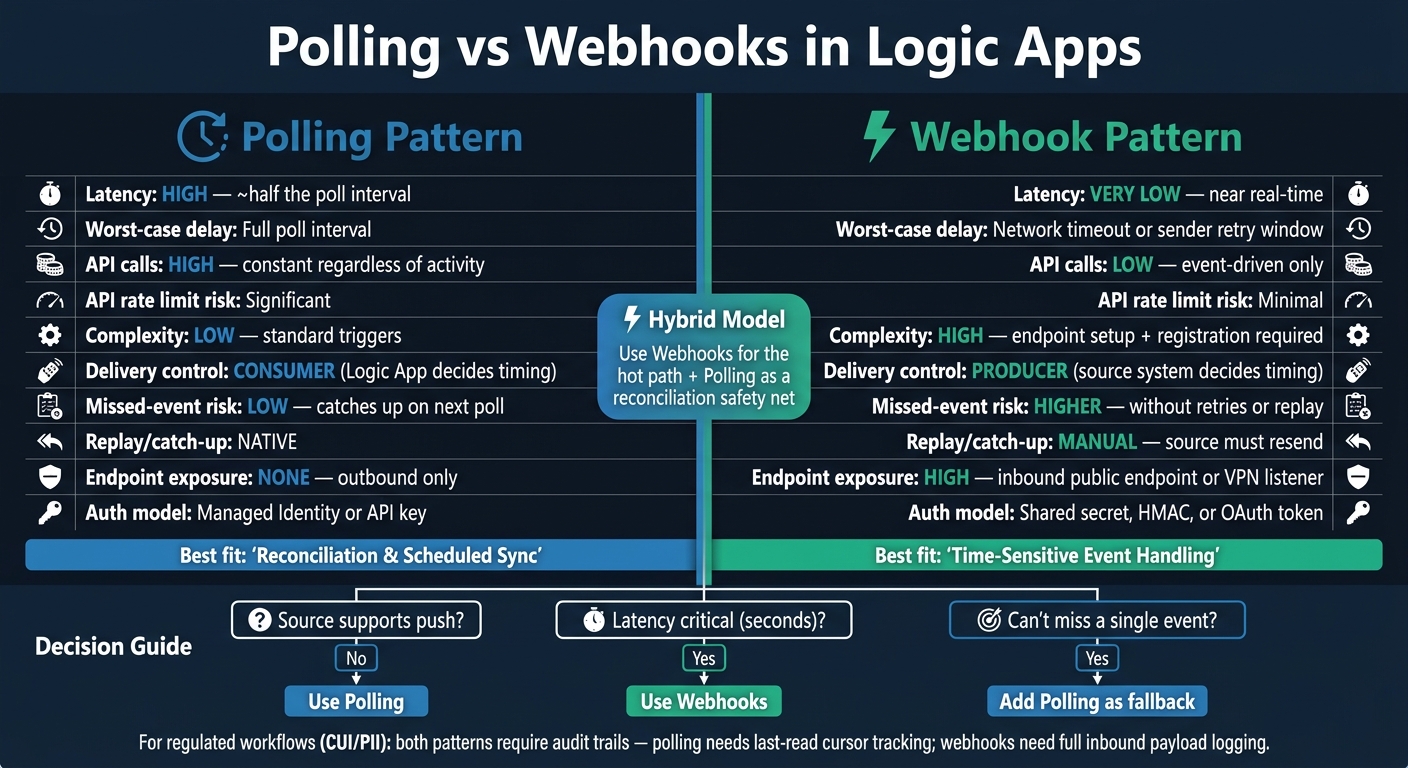
Polling vs Webhooks in Logic Apps: Enterprise Pattern Comparison
A side-by-side view makes the production trade-offs much easier to judge. In practice, this choice usually comes down to speed, traffic, and operational control. For enterprise Logic Apps, the best fit is the pattern that matches latency, governance, and failure recovery at the same time.
Comparison table: latency, load, complexity, and delivery control
Start with this table if you’re weighing speed against traffic. It gives a clear look at how each pattern behaves under day-to-day load.
| Dimension | Polling Pattern | Webhook Pattern |
|---|---|---|
| Average latency | High - about half the poll interval | Very low - near real-time |
| Worst-case delay | Full poll interval | Network timeout or sender retry window |
| Calls per day | High - constant, regardless of activity | Low - event-driven only |
| API rate limit effect | Significant - can exhaust limits quickly | Minimal - event-driven |
| Implementation complexity | Low - standard triggers | High - requires endpoint setup and registration |
| Delivery control | Consumer - the Logic App decides when to check | Producer - the source system decides when to push |
Delivery control is the key split here. It determines who owns timing: the Logic App or the source system.
Comparison table: failure modes, recovery, and security review
Speed matters, but it isn’t the whole story. In many enterprise setups, recovery and security are what settle the decision.
| Dimension | Polling Pattern | Webhook Pattern |
|---|---|---|
| Missed-event risk | Low - state-based; catches up on next poll | Higher without retries or replay; missed delivery can drop the event |
| Replay / catch-up | Native - polls whatever state is current | Manual - requires the source to replay or resend |
| Endpoint exposure | None - outbound calls only | High - requires an inbound public endpoint or VPN-restricted listener |
| Authentication model | Managed Identity or API key | Shared secret, HMAC signature, or OAuth token |
| Common misconfigurations | Polling too frequently; no last-read state tracking | Missing signature validation; no idempotency key |
| Monitoring focus | Poll success/failure rate | Endpoint availability and 4xx/5xx error rate |
| Audit requirements | Must track last-read state to prove coverage | Must log all incoming payloads for traceability |
For regulated workflows, especially ones that touch CUI or PII, the audit row isn’t optional on either side. Polling needs a dependable last-read cursor. Webhooks need a full inbound payload log. That’s the kind of detail teams often skip at first, then scramble to fix later.
When a hybrid model is the better answer
Sometimes neither pattern does the whole job on its own. That’s where a hybrid model makes sense.
Use webhooks for the hot path, where near real-time handling matters most. Then use polling as a reconciliation safety net to catch missed events or cover downtime. If you need both speed and recoverability, this is often the safest place to start.
How to choose the right pattern for regulated workflow automation
Pick the pattern based on constraints, not personal taste.
Decision criteria by latency, system constraints, and governance
Start with business limits first. That usually clears the fog fast. Three questions do most of the work:
- Does the source support push delivery? If not, polling is your only choice.
- How much latency is acceptable? If delay breaks the workflow, start with webhooks.
- Can you tolerate a missed event? If not, use polling only as a reconciliation fallback.
Governance is mandatory no matter which pattern you use. For workflows that touch CUI or PII, the required controls are hard-block CUI, PII alerts, RBAC, and audit trails.
Where Ryshe fits in Logic Apps integration design
In enterprise automation, governance often ends up deciding the final pattern.
Ryshe works with AEC, manufacturing, and aerospace organizations on senior-led AI, data, and automation delivery, including Azure system integrations and workflow automation. That work often means choosing a pattern that fits the source system, the latency requirement, and the governance model - including hard-block CUI, PII warnings, role-based access control, and full audit trails via Application Insights to meet professional liability requirements. [1]
Ryshe’s Quanta gateway adds policy enforcement, observability, and append-only audit logs to workflow automation.
Conclusion: the simplest reliable model usually wins
Once source support, latency, and governance are clear, the choice usually gets narrower fast. Start with the simplest pattern that meets latency, source support, and governance.
FAQs
How do I choose the right polling interval?
Choose a polling interval by balancing responsiveness against API load. Shorter intervals cut detection delay, but they also send more requests. In practice, teams often set session and message refreshes to 10 to 11 seconds.
It also helps to think about throttling and reliability. Poll too often, and you may run into rate limits or burn through API calls for no good reason. That’s why error handling matters. If a poll fails once, it may just be a blip. But if errors keep happening, that can be a sign the channel isn’t receiving data.
What makes a webhook reliable in production?
A production webhook is reliable when it does four things well: it checks that inbound requests are legit, deals with retries without doing the same work twice, stores state so events can be replayed after reconnects, and confirms high-stakes outbound actions instead of just hoping they landed.
- Verify authenticity with signature validation.
- Use idempotency keys to prevent duplicate processing on retries.
- Keep persistent state to support replay after reconnections and avoid stale traffic.
- For critical outbound actions, use synchronous request-reply instead of fire-and-forget.
When should I use both polling and webhooks?
Use both when you need a hybrid setup across different data sources or when connectivity gets in the way. Webhooks work best for real-time, event-driven communication when a platform can push data to a reachable endpoint.
Polling comes into play when a system sits behind a firewall or NAT, or when a service doesn’t support webhooks. Using both can make integrations more reliable when some components connect off and on or can’t accept inbound traffic.