Here’s the short answer: AI can help sort airworthiness evidence, but people must make the compliance call. In FAA- and EASA-regulated work, AI may search, classify, summarize, trace, and flag records. It must not approve, certify, or decide conformity.
What matters most is control:
- AI handles support tasks
- Humans own approval
- Every AI step needs an audit record
- Low-confidence or rule-fail cases must go to a person
- LLM drift matters: about 0.3% of records changed when reprocessed, even at temperature 0
So if you use AI in this workflow, the rule is simple: keep AI on prep work, keep humans on judgment, and log everything.
A fast way I’d frame it:
| Area | AI can do | Human must do |
|---|---|---|
| Evidence handling | Search, sort, summarize, map, flag | Check outputs and accept or reject them |
| Compliance status | Suggest issues for review | Decide sufficiency, close findings, declare conformity |
| Certification prep | Draft matrices and organize source files | Own claims, validate text, approve final records |
| Audit trail | Produce logged inputs and outputs | Add disposition, rationale, timestamp, and user ID |
Bottom line: AI may assist the review. It cannot become the review authority.
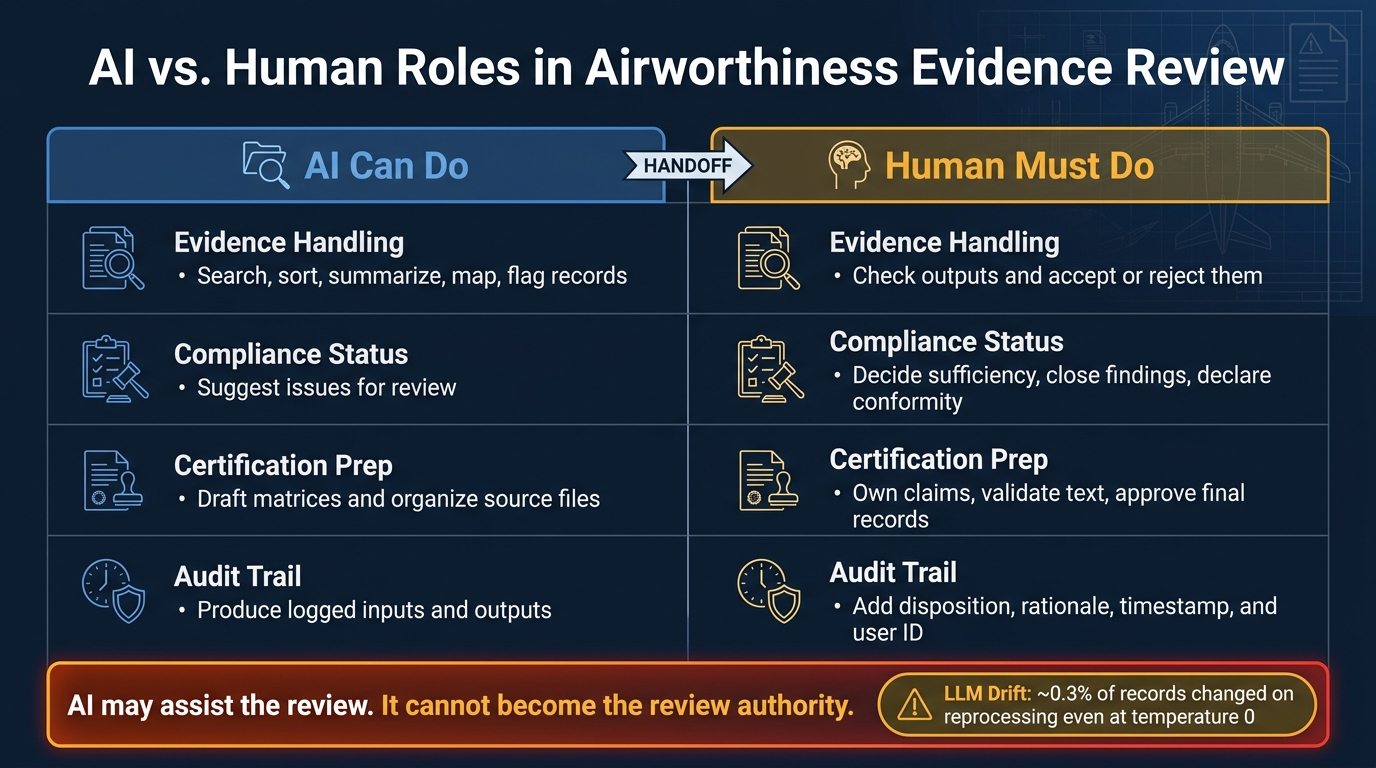
AI vs. Human Roles in Airworthiness Evidence Review
What AI is allowed to do in airworthiness evidence workflows
AI has a narrow but useful job in airworthiness evidence review: it can help move evidence through the process faster, but it cannot make compliance calls. That distinction matters. AI can support the work, set up the review, and point people to likely issues. It does not have approval authority.
Permitted AI tasks: search, summarization, classification, and traceability
AI works best on the front end of evidence handling. That includes document triage, requirement mapping, summarization, duplicate detection, and traceability checks.
For example, AI can draft a structured summary of a long test report or compliance report so a reviewer has a clear starting point. That saves time. But the summary is still just a draft for the reviewer to check, not a finding on its own. AI helps prepare the review; the authorized human owns the disposition. If AI flags a gap, the next move belongs to the human reviewer.
Where AI assistance ends and approval decisions begin
AI can flag an issue. A qualified human closes it.
If AI spots a missing artifact or a possible mismatch, that item should go into a human review queue. The qualified reviewer then decides whether the deviation is acceptable, whether more evidence is needed, or whether the finding can be closed. AI does not declare conformity.
Any fields that set compliance status should rely on deterministic rules and send exceptions to human review. The same idea applies to confidence scores: low-confidence outputs should be routed to a reviewer instead of passing straight into the compliance record.
| Task | AI role | Human role |
|---|---|---|
| Document assembly | Compile evidence packages from source data | Review and approve the package |
| Requirement mapping | Link evidence to applicable requirements | Verify sufficiency of the evidence |
| Anomaly detection | Flag missing data or mismatches | Decide if deviations are acceptable |
| Audit readiness | Monitor continuously and identify gaps | Close findings and declare conformity |
That handoff marks the line between assistance and approval. Once AI flags a gap or mismatch, the human review process takes over.
Approval authority, human control, and exception handling
Once AI spots a gap, a person steps in and makes the call. Approval authority stays with the authorized human reviewer. AI helps with the review, but it does not approve anything.
Who holds approval authority in an AI-assisted review
Authorized human reviewers keep full decision rights. AI outputs are advisory inputs - nothing more. That line matters most in cases where output needs to be routed or rejected rather than passed through by default.
For critical fields, AI has no approval authority and should be taken out of the decision path altogether. Plausible but wrong outputs can slip past review more easily than obvious parsing errors. That’s why sensitive fields need to stay rule-based. If something fails, it goes straight to a human reviewer.
How an AI flag moves to a human disposition
AI flags a possible gap, then a qualified reviewer checks it and makes the final disposition. Every outcome must be documented with a rationale and a timestamp.
Confidence thresholds send uncertain outputs to human review. If an AI output falls below a defined confidence threshold, it does not move forward automatically. It goes to a human triage queue instead.
The same control model applies when AI is used to prepare certification materials. This approach is central to AI compliance documentation in aerospace and defense sectors.
How AI can support certification preparation without becoming a source of authority
Certification prep follows a simple rule: AI can organize the evidence, but people own the claim.
AI can help pull together the pieces that go into a certification package. But when it comes to any formal compliance claim, that claim must be made, checked, and owned by a qualified human.
Using AI to organize inputs for certification packages
AI can extract references, sort test reports, material certificates, and traceability records, and draft traceability matrices for human review. In one deployment on an air-gapped network, AI reduced technical data package compilation from 4 weeks to 3 days. [1][3]
That kind of support is useful. It saves time on the paperwork-heavy parts of the job and helps reviewers get to the right source files faster.
Still, any narrative sent to a certification authority must be validated and owned by qualified personnel. An AI-drafted traceability matrix is the starting point, not the finished compliance case.
Limits on AI-generated analysis in formal compliance records
Do not use AI output as the basis for a regulatory claim. Rules-based pipelines are deterministic; LLMs are not. In a regulated audit trail, that variability creates a problem. [2]
So what does that mean in practice?
- Any AI-assisted material must be checked by a human before it affects a certification argument.
- That review needs traceability back to the source documents.
- The audit trail should record the input and the model version.
- AI-generated summaries and draft analyses stay in the working file until a qualified reviewer has checked them, fixed anything that needs fixing, and signed off.
A good way to think about it: AI does the sorting, mapping, drafting, and gap-flagging. Humans do the validating, approving, authoring, and dispositioning.
Those human checks need to appear in the audit trail with source references and reviewer signoff. Once validated, the materials can move into the governed audit trail.
Audit trail, model governance, and use limits for AI in compliance workflows
If human approval is still the final decision point, the audit trail has to show that plainly. The moment AI becomes part of a compliance workflow, the record needs to show which model was used, what went in, what came out, and what the human reviewer decided.
What the audit trail must capture in AI-assisted evidence review
Every AI-assisted step in an evidence review needs a full audit record. That means logging the model ID and version, prompt context, raw output, source links, and the reviewer’s disposition, timestamp, and user ID.
Model versioning matters because LLMs are non-deterministic. In plain English, the same kind of request can produce slightly different results over time. Even small output drift can turn into unexplained record drift in a regulated audit trail.[2]
The table below links the main control types to day-to-day setup and the compliance value each one adds:
| Control Type | Example Implementation | Compliance Value |
|---|---|---|
| Model Versioning | Log unique model ID and version | Ensures reproducibility and identifies logic changes over time |
| Input/Output Logging | Capture full prompt context and raw AI response | Provides a complete record for audit review |
| Human Disposition | Digital signature or annotation on AI-suggested flags | Establishes clear accountability and human-in-the-loop control |
| Source Traceability | Deep links to source material certs or test reports | Supports AS9100 and ITAR data-lineage requirements |
| Access Controls | Entra ID SSO and Role-Based Access Control (RBAC) | Prevents unauthorized access to CUI/ITAR-controlled data |
| Policy Enforcement | Hard-stop CUI detection and PII warnings | Mitigates risk of data exfiltration or privacy violations |
A good rule of thumb: use deterministic rules for structured fields, and keep LLMs focused on unstructured text. That split helps avoid messy edge cases where a model starts “guessing” in places where the record needs exact, repeatable values.
Using governed AI infrastructure to enforce policy and observability
Logging by itself won’t cut it. Policy has to be enforced at the platform layer too. The infrastructure should enforce policy, log each action, and preserve an immutable audit record.
That means AI access can’t be a free-for-all. Each role needs clear limits on what AI may do, what it may not do, and what human control has to sit on top.
| Model Role | Allowed Use | Prohibited Use | Required Controls |
|---|---|---|---|
| Drafting/Assembly | Compiling technical data packages from source records | Final certification of document accuracy | Human review of all generated drafts |
| Classification | Suggesting ITAR/EAR categories based on USML/CCL | Final jurisdiction determination | Empowered Official sign-off |
| Data Extraction | Parsing free-text fields (addresses, notes) | Generating numeric values for safety-critical specs | Confidence-based routing to human review |
| Routing | Directing documents to reviewers based on metadata | Bypassing required signature authorities | Audit trail of all routing decisions |
This setup keeps AI in a support role. It can help sort, draft, parse, and route, but it does not get to make the compliance call.
Conclusion: Clear role boundaries for AI in airworthiness evidence review
The rule is simple: AI can speed up evidence review and flag issues, but it cannot approve or certify.
That line matters. If a wrong output enters the record looking believable, it can pass through the process without setting off a second look. And that’s where problems start. The platform has to enforce this boundary and keep the audit trail intact.
The practical takeaway is just as simple. Define what the model can do, what it cannot do, and what human control must sit over every output. Those limits should be explicit, enforced at the platform layer, and visible in the audit trail.
AI can prepare, route, and flag. Authorized humans decide. AI may support compliance work, but it cannot become the compliance authority.
FAQs
Who is legally responsible for the final compliance decision?
The empowered official is still legally responsible for the final compliance decision. AI can help move work along by handling first-pass screening, suggesting classifications, and giving supporting rationale. But it does not replace trained human judgment.
Compliance teams and legal counsel still make the call on regulatory interpretation, especially when the guidance is unclear. That line needs to stay bright. Organizations should set clear authority boundaries so accountability remains with human reviewers across the full compliance workflow.
What should happen when AI output is low-confidence or inconsistent?
Low-confidence or inconsistent AI output should go straight to a human reviewer through confidence gating. That cuts down the risk of model mistakes and makes sure only high-certainty responses move ahead without review.
When that happens, the system should flag the issue and include the right context, so the human expert can make a fast, informed call.
What must be logged to make AI-assisted evidence review auditable?
Log every AI action, including document generation, classification suggestions, and routing decisions.
Each log entry should include:
- A timestamp
- User context or attribution
- A clear record of the inputs
- The source data used
- The reasoning behind the output
The logs should also keep the full decision history, so every action and claim can be traced back to where it came from.