If you let an industrial copilot act without tight oversight, one small error can turn into legal, cost, or safety trouble.
I’d sum up the study like this: the best setups use different oversight levels for different tasks. High-risk work needs human approval. Routine work can use alerts, sampling, or exception review. And before any team gives a copilot more freedom, it needs logs, policy limits, and hard-stop rules in place.
A few points stood out to me right away:
- HITL, HOTL, and HIC each fit a different risk level
- Approval, notification, sampling, and escalation are the main intervention patterns
- Confidence-based routing cuts review load without giving up human control
- Even small error rates matter at scale:
- 0.075% hallucinated values in production pipelines
- 0.3% output variation on reprocessing, even at temperature = 0
- The safest rollout path is:
- Shadow mode
- Assist mode
- Bounded autonomy
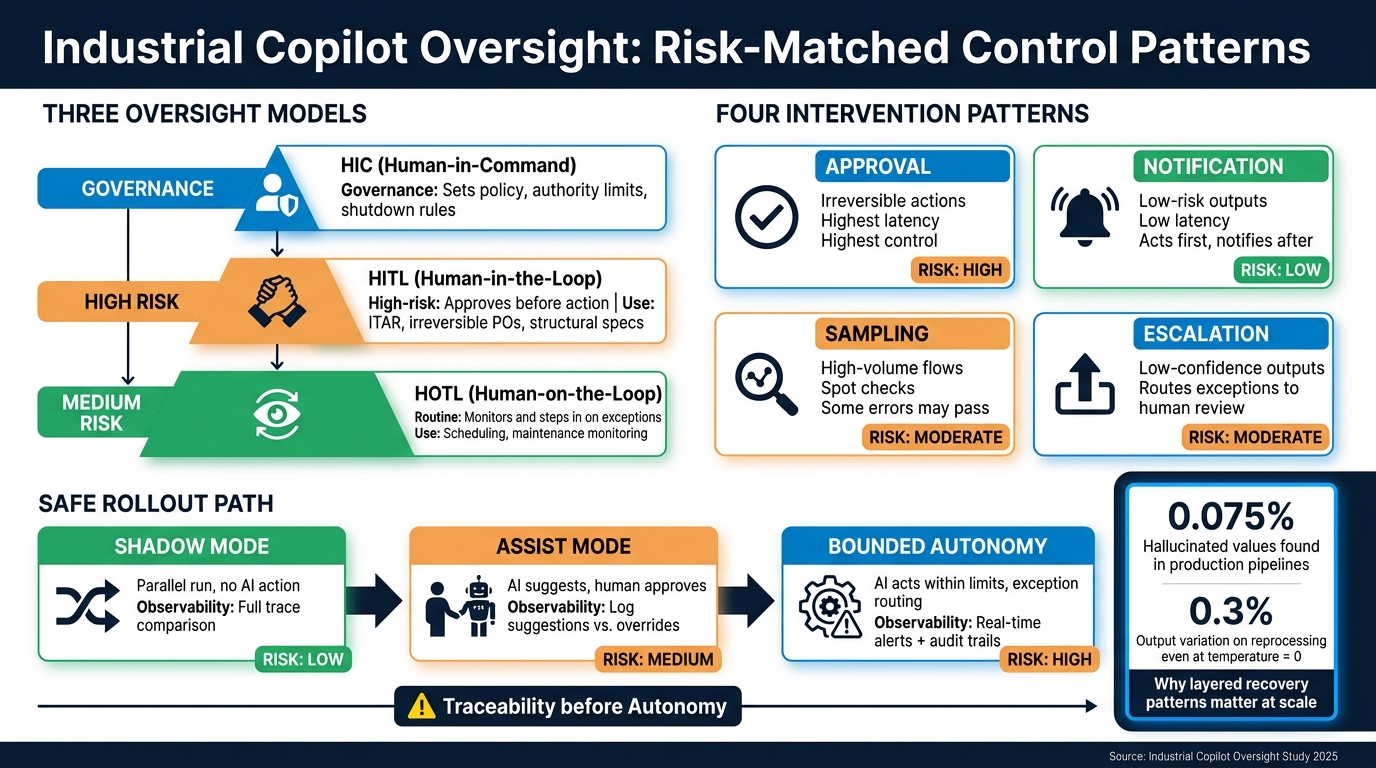
Industrial Copilot Oversight Models: Risk, Latency & Control Compared
Quick comparison
| Model / Pattern | Best use | Human role | Main tradeoff |
|---|---|---|---|
| HITL | High-risk decisions | Approves before action | More delay, more review work |
| HOTL | Routine bounded tasks | Watches and steps in on exceptions | More system risk than HITL |
| HIC | System policy and limits | Sets scope and shutdown rules | Not for day-to-day review |
| Approval | Irreversible actions | Reviews every item | Slowest path |
| Notification | Low-risk outputs | Reviews after action if needed | Less direct control |
| Sampling | High-volume flows | Checks selected items | Some errors may pass between checks |
| Escalation | Low-confidence outputs | Reviews exceptions only | Depends on good thresholds |
My main takeaway: traceability should come before autonomy. If you can’t show what happened, why it happened, and when a stop rule fired, you’re not ready to let the copilot do more on its own.
Below, I break down the oversight patterns, trust signals, failure handling, and rollout stages that this study says work best in live industrial workflows.
Oversight Models in Industrial Copilot Research
Industrial copilot research keeps coming back to three oversight models for risk control in live workflows: HITL, HOTL, and HIC. Each one matches a different level of risk and a different kind of work.
Human-in-the-Loop, Human-on-the-Loop, and Human-in-Command
HITL is used when mistakes can’t be undone or when the decision carries legal weight. Think ITAR classification, structural specs, or approval of a high-value purchase order. In these cases, the copilot can draft, suggest, or rank options, but a human still makes the final call.
HOTL works better for bounded, repeatable work such as production scheduling or maintenance monitoring. Here, the system can act on its own, and people step in only when something falls outside the norm or when the output confidence is low.
HIC operates at a different level. It sits above both HITL and HOTL. Leaders set authority limits, shutdown criteria, and scope boundaries for the full system. That isn’t day-to-day review. It’s governance for regulated industries.
A 2025 Azure-based enterprise AI hub showed this in practice through policy-driven routing, hard-stop CUI detection, and domain-specific agents for high-stakes AEC workflows. [1]
These models shape where approvals, notifications, sampling, and escalation should sit in the workflow.
Intervention Patterns: Approval, Notification, Sampling, and Escalation
This is where oversight design moves from theory into day-to-day operations. Approval gates belong in front of high-impact or irreversible actions. They slow things down, yes, but they keep human control in place.
Notification fits low-risk, routine outputs. The system acts first and then notifies the human. That keeps work moving without pulling people into every small decision.
Sampling makes sense during high-volume periods. If reviewing every output would bog the team down, spot checks can still help maintain quality.
Escalation is for low-confidence outputs. Before an item reaches approval or execution, it gets routed to a person for review. For example, if a model score drops below a set threshold, the record moves straight to a human review queue instead of passing through on its own. [2]
The point is pretty simple: where you place the intervention changes speed, workload, and risk.
Oversight Patterns Compared by Risk, Latency, and Control
More control usually means more latency and more review burden. Less control means more automation risk. There’s no one-size-fits-all setup here. The right choice depends on reversibility, workflow volume, and the cost of getting it wrong.
| Oversight Pattern | Typical Use Case | Latency | Review Burden | Best Fit Risk Level |
|---|---|---|---|---|
| Human-in-the-Loop | ITAR classification, irreversible POs, structural specs | High | High | High |
| Human-on-the-Loop | Production scheduling, maintenance monitoring | Low | Low | Medium |
| Human-in-Command | Policy setting, authority limits, shutdown conditions | N/A | Minimal | Governance / N/A |
| Approval Gate | High-impact or irreversible actions | High | High | High |
| Notification | Routine alerts, certification renewals | Low | Low | Low |
| Sampling | High-volume validation during pilot phases | Low | Moderate | Moderate |
| Escalation | Confidence failures, pricing mismatches, hallucination risk | Variable | Low (exceptions only) | Moderate |
What Research Shows About Trust, Review Burden, and Error Recovery
How Users Build Trust in Copilot Output
Trust builds when a copilot performs well in a steady, explainable way. Well-calibrated confidence scores let teams auto-route routine items and send uncertain ones to review. When users can see why the system made a call, approval tends to move faster. And when people have clear override rights, they stay in charge. Those same signals decide when the system can proceed on its own and when it needs to stop for review.
In aerospace and AEC, trust also depends on firm limits. Automatic CUI/PII detection, professional liability disclaimers on engineering calculations, and a clear split between rules-based outputs and LLM-based outputs all show that the system recognizes where it should and should not act. [1] Calibrated confidence scores and override authority are the working form of HITL and HOTL: they mark the exact point where human judgment steps back into the workflow. Hybrid systems keep structured transforms rules-based and use LLMs for unstructured input. That lowers hallucination risk without piling on extra review. The goal is calibrated trust, which requires a thorough AI Readiness Assessment.
How Teams Cut Review Burden Without Losing Control
Reviewing every AI output at scale just doesn’t hold up. The clearest fix is confidence-based dispatch: high-confidence outputs move through automatically, while low-confidence items are flagged for human review. Let automation handle structured extraction and high volume. Keep humans focused on ambiguity and high-stakes decisions. That eases queue pressure without giving up control.
Purpose-built agents also saw much higher adoption than general-purpose chatbots, which points to something simple: focused, domain-specific tools are easier to use and ask less mental effort from teams. Organizations can find the right AI starting point by evaluating their specific operational needs. In practice, that lowers review burden too. [1]
Error Handling and Recovery Patterns in Production Workflows
A parsing failure is easy to spot. A hallucinated value is harder, because it can look perfectly fine. In production pipelines, hallucinated values have shown up in roughly 0.075% of records - a small share on paper, but a serious issue at scale. [2] Even with temperature set to 0, about 0.3% of records in high-volume pipelines produced different outputs when reprocessed, which creates a hidden audit risk. [2] That’s why teams need layered recovery patterns instead of betting everything on one validation step.
| Failure Mode | Trigger | Recovery Pattern | Required Observability |
|---|---|---|---|
| Hallucinated Value | Ambiguous or sparse input | Human Escalation | Confidence scoring |
| Non-Deterministic Output | API or hardware variance | Deterministic Fallback | Reconciliation checks |
| SLA / Latency Breach | API rate limits | Async Batching | Queue depth monitoring |
| Tool-Call Failure | Schema drift | Retry with Context | Error logging and alerting |
| Unsafe Recommendation | Boundary violation | Hard-Stop Gate | CUI/PII detection |
Recovery should match the failure mode. Retries are a low-cost way to deal with short-lived technical glitches. Deterministic fallbacks protect high-risk categorical fields, where hallucinations can do the most damage. Human escalation should stay focused on low-confidence outputs and high-risk decisions, such as ITAR-related items. After an incident, teams should use what happened to update prompts and thresholds. None of these recovery rules help much unless observability tracks confidence, retries, and hard-stop events.
Observability, Governance, and Safe Rollout in Complex Environments
What Observability Must Capture for Auditable Copilot Operations
Recovery patterns only help if observability shows exactly when they fired. Teams need a clear record of copilot actions so they can audit behavior, explain outcomes, and spot unsafe moves before they spread.
That means logging hard-stop events, confidence scores, p99 latency, token usage, and cost per record. For high-stakes outputs, use append-only trails and reconciliation checks. Those records show teams when an action should be approved, escalated, or stopped.
In regulated workflows, an audit trail has to show why a transformation happened, not just that it happened.
Governance Layers That Enforce Boundaries Across Enterprise Systems
Once observability is in place, governance sets the guardrails. Observability shows what happened. Governance controls what the system may do.
In complex industrial environments, centralized enforcement of permissions, identity controls, and tool allow-lists keeps copilots inside approved boundaries across ERP, PLM, and MES systems. Policy enforcement should be automated across models and agents, with named workflow owners and clear action limits [1].
A 2025 Azure AI hub showed this pattern in practice: platform-level hard stops, PII warnings, liability disclaimers, and domain-specific agents enforced across enterprise workflows [1].
Ryshe’s Quanta enterprise AI context gateway is built for this kind of cross-system governance. It centralizes policy enforcement, observability, context control, and append-only audit records across enterprise systems.
Safe Rollout Stages: From Shadow Mode to Bounded Autonomy
With policy controls in place, rollout should test them in stages, moving from tighter oversight to more system responsibility. Shadow mode, assist mode, and bounded autonomy each increase what the system can do, so each stage needs stronger intervention controls before moving forward [2].
| Rollout Stage | Oversight Setup | Observability Requirements | Governance Checks | Risk Level |
|---|---|---|---|---|
| Shadow Mode | Parallel run; no AI action taken | Full trace comparison vs. legacy system | Data residency; PII scanning | Low |
| Assist Mode | Human-in-the-loop; AI suggests, human clicks | Log of suggestions vs. human overrides | Scoped permissions; CUI detection | Medium |
| Bounded Autonomy | Human-on-the-loop; exception routing | Real-time alerting; automated audit trails | Authority limits; named ownership | High |
In plain terms, this rollout path is about earning trust step by step. Shadow Mode lets teams compare AI behavior against the old system without letting the AI act. Assist Mode adds human approval at the click level. Bounded Autonomy gives the system room to act, but only inside defined limits, with exception routing and active monitoring in place.
Conclusion: Oversight Patterns Leaders Can Apply Now
Industrial copilots need risk-matched oversight. Not one blanket control model for every task.
The right setup depends on three things: task risk, how failure happens, and what that failure does to the operation.
Industrial copilots tend to work best when approval, notification, sampling, and escalation line up with reversibility and risk. If an action is irreversible or tied to legal exposure, a human should still approve it. But routine procurement, scheduling, and document routing can often run with exception-based review or bounded autonomy.
Once that oversight model is in place, the next pinch point is review volume. Teams build trust when they can see why the system routed something on its own or kicked it up for review. That’s where confidence-based routing helps. High-confidence outputs move forward automatically. Low-confidence items escalate. It’s a simple idea, but it cuts review burden in a big way.
There’s another practical rule here: keep structured work deterministic, and use LLMs only where judgment is needed. That avoids the cost and latency of sending everything through one LLM path. Put plainly, not every task needs the same kind of brainpower.
With routing set, governance becomes the thing that decides how far autonomy can grow. Traceability comes first; autonomy comes second. Boundary controls, audit trails, and fixed authority limits should be in place before scope expands. Shadow mode should prove observability before any autonomous action happens. Then, and only then, should teams move to bounded autonomy - and only after logging, escalation, and audit trails are working in production.
Confidence gating isn’t some nice-to-have add-on. It’s a basic safety control. Autonomy should grow only when the evidence shows it can do so safely.
FAQs
How do we choose between HITL, HOTL, and HIC?
Choose based on business risk and the places where human judgment matters most, not just what the system can do on paper. For each task, map out who has authority to decide what. That line needs to be clear from the start.
Use HITL or HOTL for routine decisions where automation can handle 70% to 80% of total volume. But when sensitive data is involved, the outcome carries high stakes, hallucination risk is not acceptable, or confidence scores come in low, keep humans in control. Set kill criteria and authorization limits before deployment so people know when to step in, when to stop the system, and who can approve the next move.
What confidence threshold should trigger human review?
Instead of relying on one fixed confidence threshold, set up human review around clear authority limits and business rules. That approach works better in practice. The system handles routine decisions on its own - usually 70% to 80% of total volume - while sending exceptions to human experts.
People should step in when the model shows low confidence, runs into edge cases, or crosses pre-set approval limits. With clear decision boundaries and audit trails, organizations keep control without slowing everything down.
What should be in place before bounded autonomy?
Before you give agents bounded autonomy, build the operating base first. That’s what keeps risk in check and helps you stay in control.
Set clear authority limits for what an agent can handle on its own and what still needs human sign-off. If that line is fuzzy, things can go sideways fast.
You also need a few basics in place:
- Trusted, connected data
- Documented real-world processes
- A full audit trail
- Aligned override procedures
- One clear owner who is accountable for AI-driven outcomes
Think of it like handing over the keys. You don’t do that just because the system looks good in a demo. You do it when the guardrails, records, and decision rights are all set up in plain English.